by Emilio Bruno
Published in US “Amateur Athlete” — June, 1955 WHAT IS JUDO? Judo is a scientific system of attack and defense applicable for hand-to-hand combat purposes. A modernization and organization of the old Jujutsu system. Judo is based upon related principles of philosophy, psychology, physics, anatomy and is unified by Dr. Jigoro Kano’s “all-pervading principle” which suggests that human energy be conserved, that activities be performed with maximum efficiency for the least expenditure of energy. WHAT SPECIAL TECHNIQUES ARE USED BY THE JUDO PLAYER? The most common are these: throwing by foot-tripping, by leg-tripping, hip, back, and waist throws, together with throwing by falling to the mat. Methods of mat fighting include holding and strangling. WHAT IS THE PLACE OF JUDO IN THE TRAINING OF OUR ARMED FORCES? Hand-to-hand combat is emphasized in various phases of training for our armed forces; Judo ranks high in its contribution here. It teaches our men the possibilities of their bodies as offensive weapons and shows how to realize them. WHAT DO YOU THINK OF THE SYSTEM OF JUDO AS A METHOD OF HAND-TO-HAND COMBAT IN THE SERVICES? Judo is essentially a Japanese sport. It is a fine thing for the morale of the American fighting men to know that they can meet and handle any emergency situation with poise, confidence, and courage. WHAT IS THE PRINCIPLE OF GIVING WAY AND THE MANNER IN WHICH IT IS APPLIED IN ACTUAL JUDO PLAY? Everyone knows that a tense muscle responds more slowly than one that is relaxed. The same is true of the mind which is kept habitually under higher tension by individuals who do not know how to relax and be calm. In each instance it would be wiser to give way to such forces instead of opposing them. WHAT IS THE EFFECT OF JUDO UPON THE PLAYER’S PHYSICAL DEVELOPMENT? It promotes health and vigor and aids in keeping the correct body weight. It is especially adapted to develop fine muscle tone. And it certainly leads to better coordination of mind and muscle in all phases of daily work and play. WHAT IS THE MOST EFFECTIVE WAY TO LEARN JUDO? There is no such thing as glancing at page 29 of a book on Judo and then going out and disarming a man coming at you with a dangerous weapon. The best way to learn is constant practice under a capable coach. WHAT WILL BE THE PLACE OF JUDO IN OUR HIGH SCHOOLS AND COLLEGES? It seems to me that World War II has encouraged a definite and new emphasis upon combatives in physical training. The excercises and body contacts provided by this type of athletic activity make our young men virile and self-reliant in peace as well as war. Combatives should be a requirement in every school curriculum. COMPARED TO OTHER SPORTS, WHAT ARE THE DIFFERENCES IN THE APPLICATION OF JUDO? Its mental and physical applications are no different from our “mouse trap” plays of football or feints of boxing, lures of wrestling, fencing, or the distraction methods in chess. These psychological approaches are evident in all forms of combat, from the simplest to the most complex. WHAT IS THE DIFFERENCE BETWEEN JUDO AND WRESTLING? There is very close correlation between Judo and Wrestling, the former, making use of jackets as a means of leverage, aims towards submission is practised on its own rules, while the latter is practised without jackets, is governed by pinning and outpointing the opponent with definite rules barring submission methods. WHAT IS THE EFFECT OF JUDO PLAY UPON ONE’S MENTAL DEVELOPMENT? The sport teaches one to be alert and ready for any emergency. But it also teaches players never to seek a quarrel. It creates this attitude by emphasizing the wisdom of giving way to the force of an opponent and by showing the benefits of relaxation and flexibility. It stresses the defensive-offensive attitude at all times. It also provides insight into human behavior in many situations requiring restraint and tact. WHAT GENERAL SOCIAL BENEFITS CAN JUDO OFFER? Judo offers definite psychological and physical benefits to its players. their mental attitudes and physical preparedness raise them far above the average. Judo has special contributions to make in social reform as advanced procedures in California penal institutions have shown. There force is not the chief weapon; persuasion, restraint, and self-control have replaced it. WHAT DOES JUDO ULTIMATELY TEACH? Above the physical advantages, Judo teaches to its disciples understanding, tolerance, patience, and self-confidence. Because he is secure in his powers, the Judo expert will be receptive to the suggestions of others, for his is humility based upon the consciousness of strength. 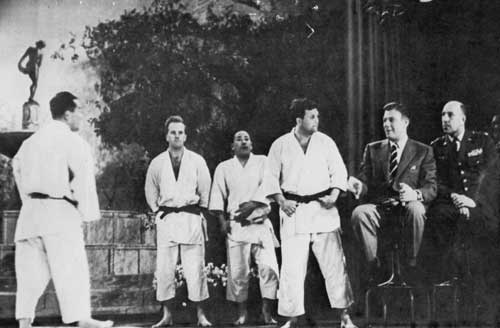
The first demonstration of Judo on national US television for the popular Arthur Godfrey Show in New York in 1954. From left to right: Prof. Kotani, Sgt. Poulin, Prof. Otaki, Emilio Bruno, Arthur Godfrey, Gen. LeMay.
Editor’s Note: I have been informed by someone who knew him that the individual identified in the photo as Gen. LeMay is not him. Online photos of Gen. LeMay do not look at all like the person in the photo. Apparently, the caption to the original 1955 article was incorrect. |